Selecting the right boat travel lift capacity is one of the most important investment decisions for any marina, shipyard, or boatyard. Among the most common configurations, 50-ton and 100-ton travel lifts represent two distinct operational levels—each serving different vessel types, workloads, and business goals.
While both are widely used in marine lifting operations, choosing between them is not simply a matter of budget. It requires a clear understanding of vessel size, operational frequency, yard layout, growth expectations, and long-term return on investment.
This article breaks down the key differences between 50-ton and 100 ton travel lifts and provides practical guidance to help marina operators make the right decision.
Understanding Travel Lifts in Marina Operations
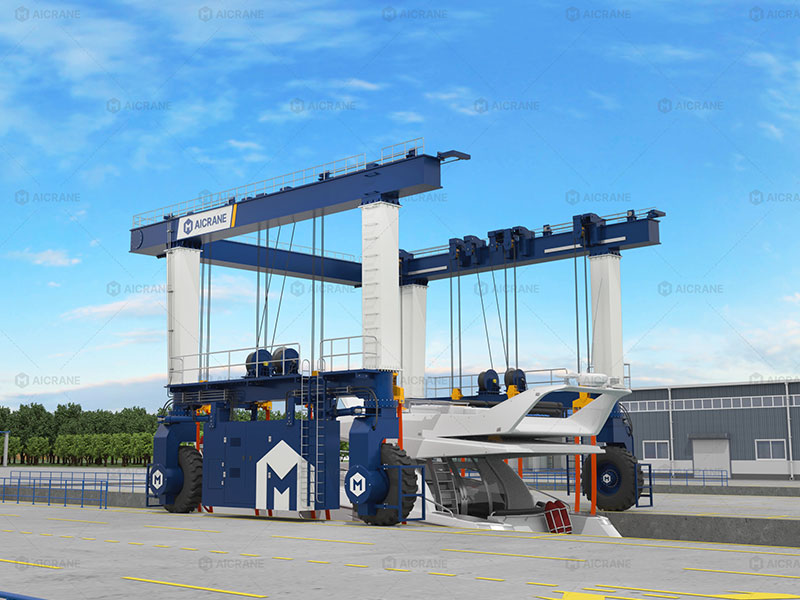
A boat travel lift is a heavy-duty mobile lifting machine designed to hoist vessels out of the water for maintenance, repair, storage, or transport. It typically uses a U-shaped gantry frame with slings or lifting straps that support the hull while the machine moves along a paved yard or slipway.
Modern travel lifts are widely used in:
- Yacht maintenance yards
- Fishing boat service docks
- Commercial ship repair facilities
- Marina storage and launch operations
Capacity is the most critical specification because it determines the maximum vessel weight the equipment can safely handle—including hull weight, fuel, equipment, and safety margin.
Overview: 50-Ton vs. 100-Ton Travel Lifts
At a basic level, the difference is straightforward:
- 50-ton travel lift: Designed for small to medium-sized vessels
- 100-ton travel lift: Designed for large yachts, commercial vessels, and heavy-duty marine operations
However, in real-world applications, the implications go far beyond weight capacity.
Typical Applications
50-Ton Travel Lift
- Sailing yachts (10–25 meters)
- Fishing boats (medium size)
- Patrol boats and small workboats
- Private marina operations with moderate traffic
100-Ton Travel Lift
- Large luxury yachts (25–45+ meters)
- Heavy commercial fishing vessels
- Offshore service boats
- Shipyard-level repair operations
Key Factor #1: Vessel Types and Fleet Composition
The first and most important consideration is the type of vessels your marina serves today—and plans to serve in the future.
A 50-ton travel lift is usually sufficient if:
- Most vessels are under 25–30 meters
- You primarily handle private or recreational boats
- Vessel turnover is moderate rather than industrial-scale
A 100-ton travel lift becomes necessary if:
- You regularly service superyachts or commercial ships
- Vessel weights vary significantly and can exceed 40–60 tons frequently
- You want to attract high-value repair contracts
Many marinas underestimate future demand. As vessels in the global leisure boating industry grow larger and heavier, upgrading later can be significantly more expensive than investing early in higher capacity.
Key Factor #2: Operational Efficiency and Throughput
Capacity directly affects operational flexibility.
A 100-ton travel lift offers:
- Faster handling of mixed vessel sizes
- Reduced scheduling conflicts
- Ability to lift heavier boats without special arrangements
- Fewer operational bottlenecks during peak seasons
A 50-ton unit, while efficient for smaller boats, may struggle in situations where:
- Two medium-heavy boats arrive close together
- Emergency repairs require immediate lifting of larger vessels
- Seasonal demand spikes increase yard congestion
In high-traffic marinas, throughput is often more important than raw lifting cost. A higher-capacity marine boat hoist can significantly improve service efficiency and customer satisfaction.
Key Factor #3: Infrastructure and Yard Design
Not all marinas are structurally ready for large-capacity travel lifts.
50-Ton Requirements:
- Moderate pavement strength
- Narrower working lanes acceptable
- Smaller turning radius
- Less demanding rail or wheel load distribution
100-Ton Requirements:
- Reinforced concrete yard surface
- Stronger ground bearing capacity
- Wider operational corridors
- Larger turning and maneuvering space
- More advanced drainage and maintenance planning
Upgrading to a 100-ton travel lift often requires yard redesign or reinforcement. This is a critical hidden cost that must be evaluated early in the planning phase.
Key Factor #4: Cost of Investment vs. Long-Term ROI
Unsurprisingly, a 100-ton travel lift requires a significantly higher initial investment than a 50-ton model. However, the decision should not be based solely on purchase price.
50-Ton Advantages:
- Lower upfront cost
- Lower maintenance and energy consumption
- Suitable for stable, predictable operations
100-Ton Advantages:
- Higher revenue potential per lift operation
- Ability to serve premium vessel segments
- Increased service pricing flexibility
- Reduced risk of losing high-value clients
In many cases, marinas that upgrade to 100-ton capacity recover their investment faster by attracting larger vessels and expanding service offerings such as refits, painting, and structural repairs.
Key Factor #5: Safety and Operational Margin
Safety is often overlooked when selecting lifting capacity for a marine gantry crane.
A key rule in marine lifting operations is to maintain a safety margin above expected maximum vessel weight. A 100-ton travel lift offers:
- Greater stability under uneven load distribution
- Improved performance in wind conditions
- Safer handling of asymmetrical or modified vessels
A 50-ton lift operating near its maximum capacity more frequently increases:
- Mechanical stress on lifting systems
- Wear on hydraulic components
- Operational risk during lifting and transport
From a long-term safety management perspective, operating below maximum capacity is always preferable.
Key Factor #6: Future Growth Strategy
A marina is not a static business. Growth trends in the marine industry show:
- Increasing yacht sizes globally
- Higher demand for professional maintenance facilities
- Expansion of recreational boating markets in coastal regions
Choosing between 50 tons and 100 tons is also a strategic decision about where your business will be in 5–15 years.
A 50-ton lift supports:
- Stable small-to-mid market operations
- Local marina services
A 100-ton lift supports:
- Expansion into regional shipyard services
- Attraction of international yacht traffic
- Diversified revenue streams
Side-by-Side Comparison
| Feature | 50-Ton Travel Lift | 100-Ton Travel Lift |
|---|---|---|
| Vessel Size Range | Small to medium boats | Large yachts & commercial vessels |
| Investment Cost | Lower | Higher |
| Yard Requirements | Moderate | Heavy-duty infrastructure |
| Operational Flexibility | Limited for heavy vessels | Very high |
| Maintenance Demand | Lower | Higher but manageable |
| Revenue Potential | Moderate | High |
| Future Expansion | Limited | Strong |
Common Selection Mistakes
Many marina operators make the following errors:
Choosing only based on current demand
Ignoring future growth leads to early capacity limitations.
Underestimating vessel weight
Modern yachts often exceed expected displacement due to equipment upgrades.
Ignoring yard reinforcement costs
A higher-capacity lift without proper infrastructure is unsafe and inefficient.
Focusing only on purchase price
Operational revenue potential is often more important than initial savings.
Practical Decision Guide
Choose a 50-ton travel lift if:
- Your marina is focused on small-to-mid recreational boats
- Budget and infrastructure are limited
- Vessel growth is not expected in the near future
Choose a 100-ton travel lift if:
- You handle large yachts or commercial vessels
- You want to expand service capabilities
- You are building a long-term, high-capacity marine facility
- You aim to increase revenue per lift operation
Conclusion
The choice between a 50-ton and 100-ton travel lift is ultimately a strategic business decision, not just a technical one. While a 50-ton system may be sufficient for smaller marinas with stable workloads, a 100-ton travel lift opens the door to higher-value operations, greater flexibility, and long-term business expansion.
For many operators, the real question is not “What do we need today?” but rather “What kind of marina do we want to become?”
Investing in the right capacity ensures safety, efficiency, and profitability for years to come—making it one of the most important infrastructure decisions in any marine facility.